
Band 3, after a find from Raisio, Ihala, is finished.
This band is in two colors. Tablet-Woven Treasures (page 109) describes the colours as blue with the edges as ‘light yellowish’.
In my Swifter stash, I had a bit of fiber that is dyed ‘light yellowish’. It is a bath of Weld that did not take quite well. I have spun that fiber for the edges.
I wove again with the technique of the ‘Iron Age Swivels’ I described in post 8. So the band, which has a final length of 140 centimeters, has no turns.
The band I wove is 8 mm wide, the book states the find was 6 mm wide. The yellow fiber I used for the edges, was a ‘leftover ‘bit of Swifter. It had many nepps and noils, and coarser fiber. So the yellow yarn turned out a little bit thicker than the blue. The difference is visible in the edges.
With the yarn spun smooth (or ‘worsted’), the stitch definition is good, even on this small scale.
The ‘knots’ part of the ‘swivel’ set-up for this band:
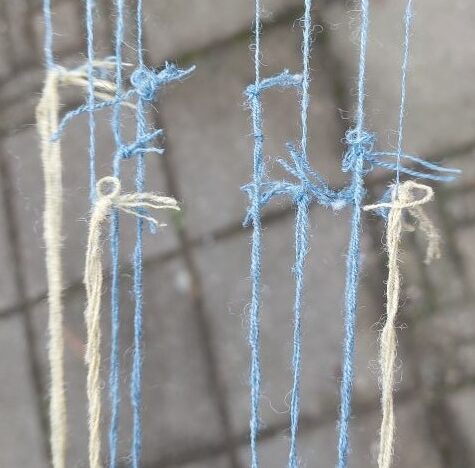
(For sake of clarity: I talk about ‘Iron Age Swivels’ in a casual way. It is not a technique that is based on an archeological find. It is a technique I use to achieve the result of ‘a band without turns of direction’, without the use of modern means like iron swivels. So it is a ‘sticks and string’ technique based on the principle that twist travels to the thinnest point).
This is a post about weaving Finnish Iron Age bands with spindle spun weaving yarn. I weave the bands listed in the book ‘Tablet Woven Treasures, Archaeological Bands from the Finnish Iron Age’ by Karisto & Pasanen (2021), one by one in the order of the book.